

Introduction
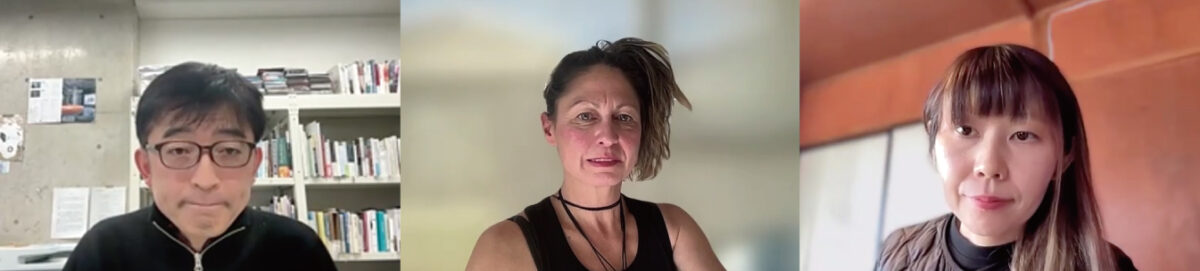
[TAKADA] Kia Ora. Today, we will share perspectives of both Māori and Japanese cultures on natural disasters and beliefs (myths) with artist Linda LEE from the Shared Lines Project*, and art anthropologist and mythologist ISHIKURA Toshiaki of the Akita University of Art, where he works there as an associate professor there. (Read more)
At first, let me introduce Linda. She strongly integrates her indigenous roots, knowledge, and self-expression of Māori culture into her production which includes project management and artwork creation. She reeconstructs and analyzes elements of shared cultural identity and history through non-verbal expression.
First, let me introduce Linda Lee. Linda Lee strongly incorporates her own Maori heritage and knowledge and perspective on indigenous Maori culture into her work and project management, reconstructing and sharing cultural identity and history through non-verbal expression.
Linda discovered she was whāngai – adopted – at age 19, and as a mixed-race artist of Māori, Chinese and Dalmatian/Croatian descent, she started to explore her identity, researching and reinterpreting family, whakapapa (genealogy) and even indigenous history through exhibition formats such as photography, text, and installations. Her ongoing research into matauranga (indigenous wisdom), laranga (traditional weaving craft), rongoa (therapy), and te leo (Maori language), along with disaster management, is woven into her long-standing artistic practice.
Currently living in Te Whanganui-a-Tara, Wellington, Linda runs Ōtari Raranga – a learning space and textile collective for Māori weaving – and co-runs Urban Dream Brokerage, an organization that provides space for new community-building ideas from artists, creatives and social activists. After completing an exchange program with artists in Miyagi from 2011 to 2013, she continued her studies in art management and recently began studying whakairo (Māori woodcarving) at Te Wānanga o Raukawa in her hometown of Ōtaki.
Meanwhile, ISHIKURA Toshiaki has done field research in various places in South Asia such as Sikkim, Darjeeling, Kathmandu, as well as in Eastern Japan, and has been conducting artistic anthropological research on comparative mythology research and the images of non-human species in the Pacific Rim. He has also collaborated with artists and musicians. In 2019, he participated in the Japan Pavilion exhibition “Cosmo-Eggs” at the 58th Venice Biennale. In addition, he has co-authored works include “Wild Tours: 12 Journeys Through the Myths of the Japanese Archipelago” and “Lexicon: Contemporary Anthropology.”
—————————————
*Shared Lines Project (Sendai–Christchurch Art Exchange): An art exchange project launched in 2012 between artists from Aotearoa, New Zealand and Miyagi Prefecture. It aims to connect two regions that have experienced natural disasters, fostering regional regeneration and international cooperation through art.
*Whāngai: A Maori tradition where children are raised by relatives or other people aside from their biological parents.
*Pakeha: A Maori term used in Aotearoa, New Zealand to refer to non-Maori residents, primarily of European (Caucasian) descent.
The Back Story
[TAKADA] Linda, what motivated you to undertake this research?
[LEE] Following the Shared Lines: Art Exchange, I met Professor TSUKAMOTO Itoku* (specializing in art theory, indigenous mythology, and Play Therapy) during his research travels around Aotearoa New Zealand in 2016. (Read more)
He stayed at my residence and introduced me to Japanese indigenous myths about natural disasters, including the Namazu, or catfish. He also told about the tsunami stone markers in the Tohoku region. They were inscribed with messages that are to the effect of “Do not build below here because of tsunami”. Over time, nature has grown over many of them. I think of this as intergenerational knowledge, voices from our tūpuna (ancestors) and like tohu, or signs.
Since the Shared Lines: Christchurch x Sendai Art Exchange, which I organized from 2011 to 2013, I have been interested in learning about the different cultural approaches Japan and Aotearoa New Zealand have taken to natural disasters, and the similarities and connections between them. Much has happened with the Shared Lines project both before and after COVID-19, so I will not go into detail here — much of which fueled my desire to continue research on indigenous narratives and disaster management.
In 2024, I co-organized the first phase of Shared Lines: Ramat Kor Kur in Te Whanganui-a-Tara (in Wellington). This was the first Ainu art exhibition to be held in Aotearoa New Zealand, and featured works by four Ainu artists: Akemi SHIMADA, KOJI Yuki, OGASAWARA Sayo, MONBETSU Atsushi and IGUCHI Yasuhiro. SHIMADA’s work was donated to the National Museum of Aotearoa, Te Papa Tongarewa.
The Ainu are an indigenous group from Northern Japan. “Ainu” means human. Ainu are distinct from from kamui/kamuy or divine beings, which reside in all natural objects. As I spent time with them, I became increasingly aware of the similarities between Māori and Ainu cultural and spiritual beliefs, as well as our shared struggles to maintain our indigenous identities. Prior to my stay in Japan (in Shiogama, Miyagi) for this research, I attended the annual Ainu Chipsanke Festival in Nibutani, Hokkaido, in late August 2025 to reconnect with the artists who joined the Ramat Kor Kur event. In this research project, we had opportunities to explore and rethink our approach to te taiao, or ‘the natural world’, through different cultural perspectives amid rapid changes in our modern environment and society.
—————————————
*TSUKAMOTO Itoku graduated from the Musashino Art University. As a Danish government exchange student, he studied early childhood education, social education, and adventure playgrounds at the Flobel Seminary in Copenhagen, Denmark. He researched play and art therapy from a Jungian psychological perspective at the Musashino Art University Graduate School and the Jung Institute in Zurich, Switzerland, and continues into practice after graduation. Drawing on his experience of giving lectures, workshops, and doing fieldwork overseas, he is engaged in researching on indigenous and traditional cultures and activities and passing them on to future generations.

[TAKADA] Could you give us a little background about Māori mythology?
[LEE] In Māori mythology, there are many Atua (supernatural beings or deities) that exist in the natural world and within us. For example, specifically relevant here: Tangaroa is the God of the ocean and its creatures; Tawhirimatea is the god of weather, including wind and storms. Ruaumoko is the god of earthquakes and volcanic activity, who lives inside the Earth. (Read more)
Similar to the Ainu language, “Māori” translates to “nature”, and “ordinary people”.When it comes to our creation traditions, many iwi (tribes) have differing perspectives, so I can only speak for my own journey, but there are important commonalities In our shared origin, we are said to have passed from Te Kore, a world of darkness, to Te Ao, a world of light: Ranginui (the sky) and Papatūānuku (the earth). Originally, embraced tightly together, and their children were born between them in darkness. The children separated their parents to allow light to come into the world. This separation is commonly attributed to Tane-mā-Huta, god of forests, birds and insects. After this, the children became Atua (gods) who shaped the natural world.
Some iwi talk about a supreme being called Io, whilst historians have debated whether Io is a pre-European or post-European concept, and whether the latter is affiliated with Christianity. I believe that Io predates European contact with Māori nations. It was not commonly spoken of, appearing only in manuscripts in the late 1900s. However is was a secret known only to the tohunga (or priests in “Māori”). Significantly, Io has existed in Aotearoa and in other Pacific islands long before the Māori. I believe this was foundational to our early understanding of navigation.
To me, Io is like ART, the spark of creativity, inspiration to seek out, to search, to wander (in Aboriginal terms), to dream, and to serve as inspiration for daring journeys. For instances, on voyages between Aotearoa and South America, kumara was brought over in search of crops that would be suitable to the Aotearoa climate.
Creation stories influence many aspects of Te Ao Māori*, the Māori worldview. The similarities and repetitions of narratives across various whakapapa (ancestry) in their ancient iwi genealogy stories (often going back to Hawaiki – the original land from which all Pacific nations voyaged) can be compared to pūrākau, or legends reflecting the creation stories of Te Āo Māori.
*Te Āo Māori: A concept referring to the totality of the perspective, culture, worldview, language, and values of the indigenous Māori people (the Māori world).
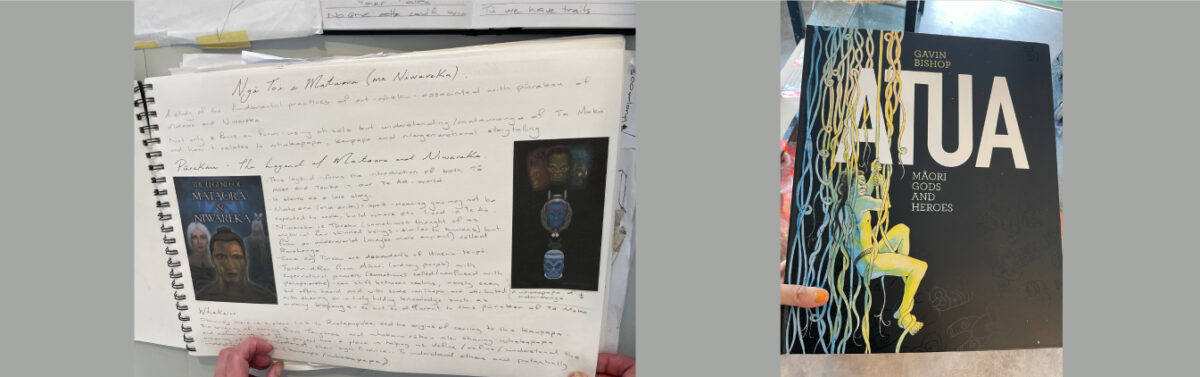
The Atua are seen as role models for human behavior. My research encourages us to understand how nature protects us as our kaitiaki (protector/guardian), and how the tohu (signs) indicate an imbalance in nature and the world, and how we can use our various senses to pay more attention to our surroundings. (Read more)
[TAKADA] Given that humanity has long tried to control nature, humanity itself should seriously listen to what nature is communicating.
[LEE] Āe (Yes). I believe that’s true. We are responsible for the demise of nature and its impact, but in Te Ao Māori and pūrākau (myths and ancient legends), nature is our kaitiaki (guardians). It is the kaitiaki who give us tohu (signs and signals) when something is wrong. Nature and humankind are all interconnected in this world.
[TAKADA] Your research also focused on taniwha*, which is known to be both a water guardian and monster. Could you share more with us about it?
[LEE] In Māori mythology, taniwha are supernatural beings. They are water-dwelling creatures, and they are also kaitiaki (protector gods) who were said to have guided voyaging waka (boats). But they have been known in pūrākau (mythology) to devastate the land and its communities (Read more).
In our whakapapa (ancestry), the commander is at the top of the genealogical chart. They always sailed with the help of a tūhunga (who could navigate the stars) and often guided by a taniwha. In some instances, the tohunga could change into a taniwha (with either good or bad intentions).
In modern times, there was a legendary guide known by the name Perolus Jack, a dolphin who often guided ships through the French Pass, which separates Rangitoto (ki te Tonga – to the South) D’Urville Island from the South Island of Aotearoa New Zealand. This dolphin/kaitiaki (guardian/deity) acted as a guide from the late 1800s to the early 1900s. Many Māori believed he was a taniwha named Tuhirangi in the form of a dolphin. (Note: (“Taniwha Tuhirangi” accompanied the legendary explorer Kupe on his voyage of discovery to New Zealand. Kupe is said to have placed Tuhirangi as a guardian in Cook Strait.)
In addition, there was Opo. This friendly bottlenose dolphin lived in Hokianga Harbour in between 1955 and 1956. Opo became a national icon for playing with people, especially children, before her tragic death, which sparked national mourning and led to a law protecting dolphins in the harbor. She embodied the Māori concept of a taniwha through her unique connection with humans.
*Taniwha: It is a creature in Māori mythology that possesses both the duality of being a guardian spirit protecting a place and a dangerous being that can harm humankind.

My specific interest in taniwha started after the Shared Lines Project (Part 1) in Miyagi, when I moved to Te Whanganui-a-Tara (Wellington, Aotearoa New Zealand). I learned of Ngake and Whātaitai, the two taniwha of Wellington Harbor. (Read more)
The pūrākau (myth) of Ngake and Whātaitai describes the massive Haowhenua (Earth Swallower) earthquake, which struck around 1460 AD. According to both Māori legend and geological evidence, Wellington Harbor (Te Whanganui-a-Tara) was once a freshwater lake, isolated from the sea until Ngake (one of the taniwha) broke through, creating the harbour entrance and connecting it to the ocean. This legend reflects geological changes: freshwater springs from the Waiwhetu Aquifer still flow into the harbor, though it’s now an estuary where saltwater flows in due to fluctuating tides.
Over time, both the two taniwha, Ngake and Whātaitai, grew too big for the lake. After hearing the birds’ calls about the abundance of edible fish on the other side of the lake, Ngake decided to break through to the sea with such force by coiling his body like a spring at Pito-one (The Port Town of Petone). He smashed through the southern rocks creating the waterway to Te Moana o Raukawa (Cook Strait), turning the Miramar Peninsula into an island (Motukairangi). Thereafter, parts of the seabed were joined together connecting to the mainland, and therefore creating Wellington Harbour’s current form. Whātaitai attempted to follow but was caught in shallow water as the tide went out. He became stranded and eventually died, and it is said that his remains formed the Miramar Peninsula (historically called Motukairangi). This ancient event was recorded only in Māori oral traditions, predates European settlement, and explains the region’s unique geography, a claim supported by subsequent geological evidence.
*Taniwha: It is a creature in Māori mythology that possesses both the duality of being a guardian spirit protecting a place and a dangerous being that can harm humankind.
*Taniwha Tuhirangi: Accompanied traditional explorer Kupe on his voyage of discovery to Aotearoa, New Zealand. Kupe is said to have placed Tuhirangi as a guardian in the Cook Strait.
More recently, following consultations between local iwi (tribes) and geological scientists such as Dan Hikuroa (PhD in Geology from Auckland University), tanihwa have influenced the nature of some infrastructure planning and civic works. More specifically, the relationship between Mātauranga and Scientific evidence. (Read more)
“I now work mostly on community-driven and participatory projects with Māori, including using ocean resources sustainably; plans for managing environments and natural resources; reducing the risk of disaster from natural hazards; and restoring industrial waste sites, ” Hikuroa says. His research asks: What can the weaving of Mātauranga and Science contribute to our understanding?
As an example: State Highway 1 – Meremere
“The Matatā floods, for instance, are recent, and the originally proposed route of State Highway 1 at Meremere in 2002 was underwater as a result of the flooding of the Waikato River 14 months after it was changed and completed following consultation regarding Karutahi. By contrast, the revised route, chosen to avoid Karutahi’s dwelling, was not.”
“One of Hikuroa’s examples involves the use of taniwha pūrākau in town planning. In 2005, there was massive flood damage in Matatā, on the east coast of Aotearoa’s North Island. Many buildings were completely destroyed, and the town has even now not fully recovered. There are four marae (the courtyard and complex of buildings at the centre of community life) in Matatā, and all four were unscathed. The taniwha in the local river had been taken into account in choosing the sites of the marae. This taniwha has the form of a lizard, its head in the headwaters of the river, its body long and sinuous with short limbs (tributaries), and its tail (on the low-lying Rangitāiki Plains) flicking backwards and forwards. The marae were situated where they would not be damaged or destroyed by the moving tail of the taniwha, and thus they were not damaged by the changing path of the river. At the very least, the moving tail of the taniwha represents the changing path of the river. Arguably, indeed, “the changing path of the river” and “the moving tail of the taniwha” are two ways of describing the very same thing”.
In 2002, the New Zealand Herald newspaper reported how the iwi (tribe) Ngāti Naho advised the government to reconsider construction plans on a major highway, to protect the vast space of a taniwha’s habitat. The taniwha was known to have the appearance of a large white eel, and the iwi argued – and I quote “that it must not be removed but rather move on of its own accord; to remove the Taniwha would be to invite trouble. “
[TAKADA] Was there anything else you noticed?
[LEE] I am interested in how indigenous people sought knowledge from ancestors and in the belief that there is living energy in nature, plants, and animals, and that we are all in tune with it. The traditional narratives are both fictional tales, but are based on factual events. (Read more)
In part, these may be seen as “folktale” or storytelling way of explaining things by our Tūpuna, or ancestors. Maybe they did not understand the science and the fault lines of earthquakes, but they understood the nature of the world, so they told stories and painted pictures and carved those tsunami stones (that I have seen in my research) so that future generations – their grandchildren would know and remember these “events” to keep them safe, providing a word of warning and caution.
The Research
[TAKADA] With that, let’s talk about your research in detail. (Read more)
You stayed with us here at Honda Studio here in Japan for several weeks, and during your microresidency, you have done field work in understanding various aspects of Japanese earthquake mythology, such as the Namazu catfish and the beliefs related to the Kaname-Ishi or sacred stone. We are aware that there is little information about that here in Tohoku. However, there were some spots in Miyagi and nearby prefectures that you observed and found interesting. Please tell us more about these experiences.
[LEE] My research took a turn at one point.(Read more)
At the suggestion of professor TSUKAMOTO, I wanted to visit these tsunami stones, scattered along the coast, said to be monument markers that said “Do not build below these stones,” which, over time, were overgrown by nature, and so the knowledge was lost. On the other hand, further research into the tsunami stones suggested that they could belong to one of two categories: either as a memorial, commemorating people and places lost to an earthquake tsunami, or as a teaching – providing instructions – describing events and directions as to where to build, where to evacuate to, and where water levels have risen in the past. Either way, I feel a sense of empathy that our tūpuna (ancestors) are sharing their mātauranga (wisdom) with us.
SAT and Aya shared some background information about the kanameishi, or keystone. I learned that in Japanese mythology, keystones were spiritual stones believed to calm down earthquakes. Another legend says that earthquakes were caused by the rampaging catfish on the ocean floor. The keystone was worshipped as a stone that would forever restrain the catfish that caused the earthquakes. Praying to the keystone is considered a symbolic act of praying to a stone that seals away earth-shaking forces, bringing stability between nature and humanity. Visiting Kashima Shrine (located in Kami Town), which enshrines the keystone, as well as Hidakami Shrine (Ishinomaki), which is dedicated to the worship of a water deity (mizugami), and Reiyozaki Shrine (also in Ishinomaki) were all truly fascinating. (All Shrines are located within Miyagi Prefecture).
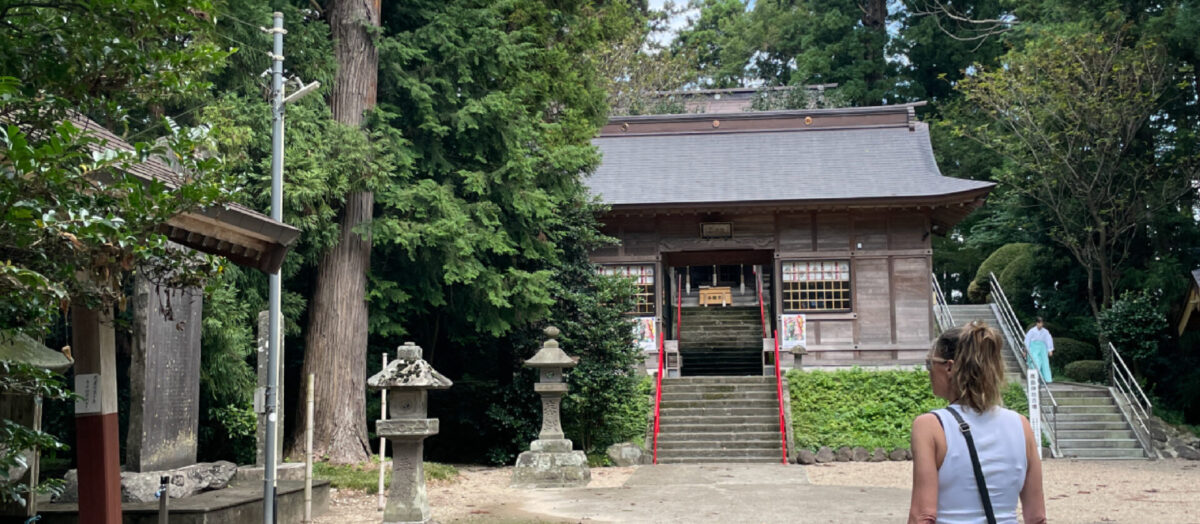
[LEE] I was particularly intrigued by the motifs often used around the keystones. These recurring motifs are similar to Māori Whakairo rākau (wood carving) and raranga (weaving) motifs and processes. I also noticed that much like with a urupa (a Māori burial site), there was a temizuya (a water purification fountain). (Read more)
This also helped me understand the teachings. For example, at the first keystone shrine I visited, I picked up a stone and was immediately bitten by a ton of mosquitoes! I was like, “So you can’t just pick up stones from here?” Aya told me, “You have to ask permission!” I obtained permission from the shrine and was allowed to take some stones home.
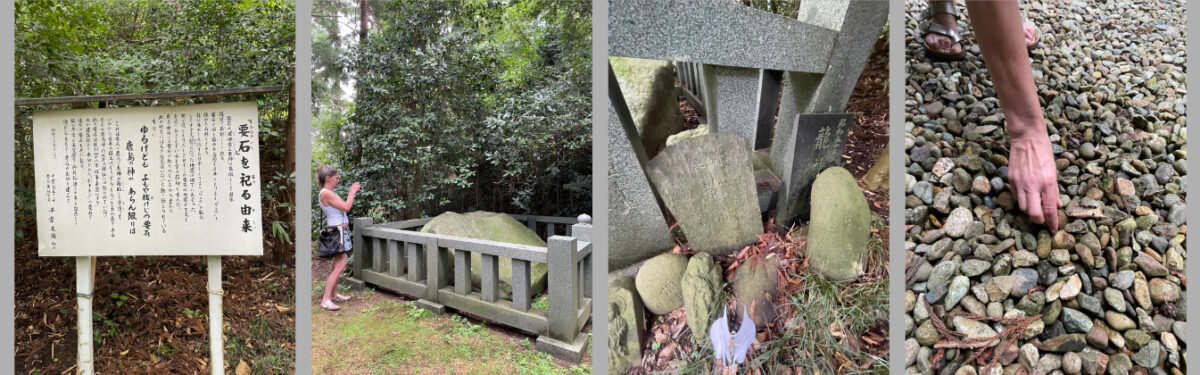
At another shrine, I was captivated by a massive 1500-year-old tree. It was like a tunnel that could crawl through, and so I did. When I leanned over to take a photo of the tree, a long, slender piece of bamboo just snapped in half without force. At the time, I was looking for bamboo to use for making nets for my studio, so by chance I was able to get some coincidentally. This experience made me feel connected to nature during my time at the keystone shrines. I didn’t had much time to to the local people about the shrines in detail, though.
I started this research out of curiosity to find the links between taniwha and Namazu (catfish). But over time, that shifted to include the tsunami stones alongside Ainu traditions and Kamuy. (Read more)
So the connection to traditions I found depended on the people living in differing locations (outside of the bustling cities). I was told that, although there are various theories, Namazu, or catfish worship is said to have begun in the Muromachi period and spread to commoners during the Edo period, while these keystones are said to date back to the age of the gods before the Common Era. I heard that in Tohoku, worship of keystones is more prevalent than worship of catfish.
Is there a correlation between the Kanameishi keystone and the tsunami stones? And I’m not sure yet if there’s a correlation between the keystones and the tsunami zone markers, which effectively remind people not to build anything beyond that point.
(SIDENOTE: According to the Nihon minzoku dai jiten (The Japanese Folklore Dictionary), as well as Kashima Shrine’s official Website, the keystone within the grounds of Kashima Shrine is enshrined as a symbolic stone sword to protect the nation of Japan, representing Take-mikazuchi-no-okami (*1). This keystone is believed to be a stone sword that appeases the “Ryu” (dragons) surrounding Japan, with the intention of maintaining a sense of peace in the country. In ancient times, the “Ryu” (dragon) represented seawater, and the “Ryu” surrounding Japan transformed into catfish.
[TAKADA] Linda points out that the oral tradition passing down the narratives of how ancestors they experienced the wrath of destruction in this case – earthquakes – and how they deal with this reality – be understood as a coping mechanism. Are there similar examples that you see in Japanese folklore and mythology?
[ISHIKURA] In Japan, folklore and mythology have also functioned as a way to pass down stories of past disasters—particularly earthquakes and tsunamis—in various forms. For instance, regarding earthquakes, stories often explain the reason behind why they occurred, frequently depicting earthquakes and tsunamis as a combined set. The Japanese archipelago, including the seabed, is situated atop volcanic belts, earthquakes occur frequently. When people consider how these events are interpreted, there was a prevailing belief that forces beyond human comprehension lie dormant within the earth. (Read more)
For example, in the southern regions of Japan, there are many myths and legends about eating a fish that speaks human language, which then triggers an earthquake or tsunami. In these stories, as the fish is about to be eaten, it pleads for its life, saying “Help me.” While fishermen would usually heed this plea and refrain from eating it, eventually someone decides to try it anyway. When they do, the sea itself—having heard that cry for help—arrives as a massive tsunami to save the fish, swallowing the land in its wake.
This type of myth is common in places like the Yaeyama Islands of Okinawa. Stories like these suggest that earthquakes and tsunamis can be triggered by sudden, specific events, and they teach us how to avoid incurring the wrath of nature. There is an underlying message that nature must be treated as a “significant other”—much like a human being—requiring respect and care. I believe similar stories exist in the Tohoku region as well. The idea is that earthquakes and tsunamis do not occur randomly or without reason; rather, they happen when a certain balance has been disrupted. Therefore, the concept of “caring” for that balance to prevent such disasters has been preserved in Japan since ancient times.
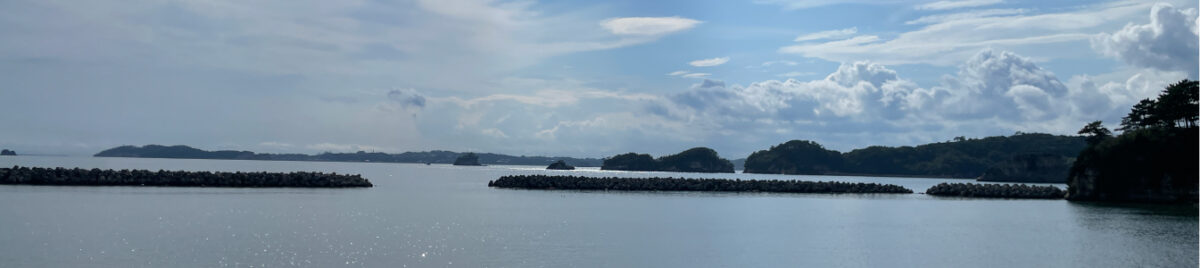
[TAKADA] On that note Linda, you have also visited the Urato Islands on Matsushima Bay. We went to Sabusawa Island, which was about a 40-minute ferry ride from mainland Shiogama city. We spent time with fellow artists, including IGARASHI Yasuaki, experiencing “Water,” “Taniwha,” & “Atua.” At one point, it was really impressive to see that you and IGARASHI found a taniwha, or driftwood, floating adrift off the coast and worked together to return it to its original location. What was the experience like and why have you felt compelled to carry it like it was a mission?
[LEE] First of all, I had no idea what kind of experience I would make out of it when I visited the Urato Islands… (Read more)
…so I am truly grateful to Aya, SAT, and to our friends in Matsushima to have this opportunity! To answer your question, I think it started… When we were on the boat to Sabusawa, all I could feel was this urge to get in the water! That desire was very present in me – to connect with it.
At that moment I began thinking and reflecting about the concept of crossing oceans and crossing time, and the navigations made by our Pasifik/Māori tūpuna (ancestors), from Hawaiki (the original ancestral home of the Polynesian and Māori people in its respective folklore), to all around the Southern Hemisphere in the Pacific ocean, particularly (in this trip to Sabusawa) because we were on this boat with a community that had moved to the Urato Islands. A few of them moved (to this island) after the tsunami, as if to return and take care of the land. I don’t here use the word Kaitiaki or guardian as it gets thrown around a lot, as if we are the guardians, (as mentioned earlier), when I believe the reverse – that nature is the kaitiaki, guardian and giver of life to us.
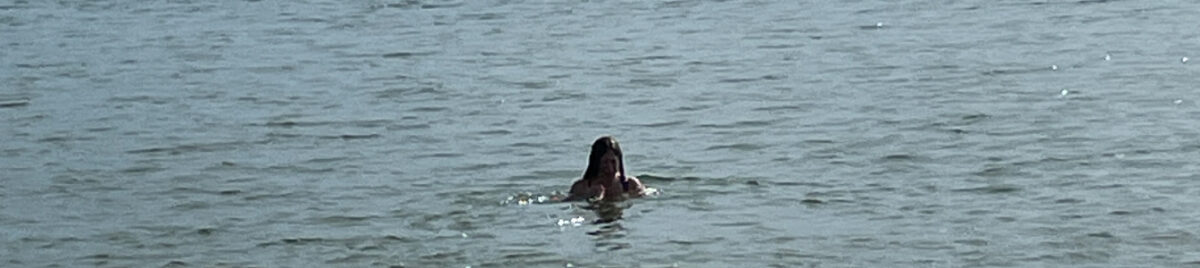
When we were finally dropped off at a beach where we could swim, IGARASHI joined us. We were actually trying to swim to another small island, and we came across this big piece of driftwood that was twice my size. We were at first using it as swim ring to stay afloat, and then it became our kaitiaki (guardian), because the further we swam, the more we realized we were getting further from the shore. It was a source of laughter and joy for us. We tried over and over again to get back, but eventually we just let the taniwha decide and ride for us for just a few seconds! It was such a beautiful moment.
I think taniwha are kaitiaki (guardian spirits) – the two are interchangeable. Taniwha are like mythical creatures, but when we try to communicate with them, I believe our tūpuna (ancestors) are communicating with us together. They warn us to stay away from certain areas because they are really dangerous. (Read more)
For instance, I was at Lake Ferry in the Wairarapa, Aotearoa New Zealand, recently, where there were taniwha too. Apparently, when heavy flooding in the maunga (mountains) behind the lake happen, the driftwood would start to show up ashore. So that would be a sign that a flood is coming. There’s meaning in passing these stories. When My Dad was a little boy, he knew where the taniwha are up in Kaitaia, northern Aotearoa New Zealand. It was for safety. It might have been sinking sand or an ocean riptide. The sign might be a fish in an unusual formation, a whale or shark appearing unexpectedly in a distinctive cycle, or simply the way the water was moving. But it meant something was changing in nature.
[TAKADA] You collected a variety of items from the islands, but from what perspective did you intend to collect them for?
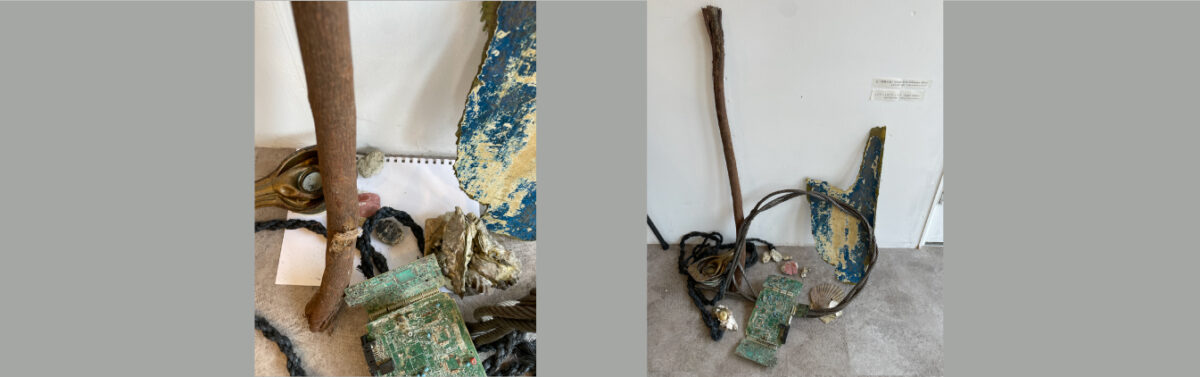
[LEE] Over there at Urato, I was really drawn to this seemingly “junk” that had washed up on the shore… (Read more)
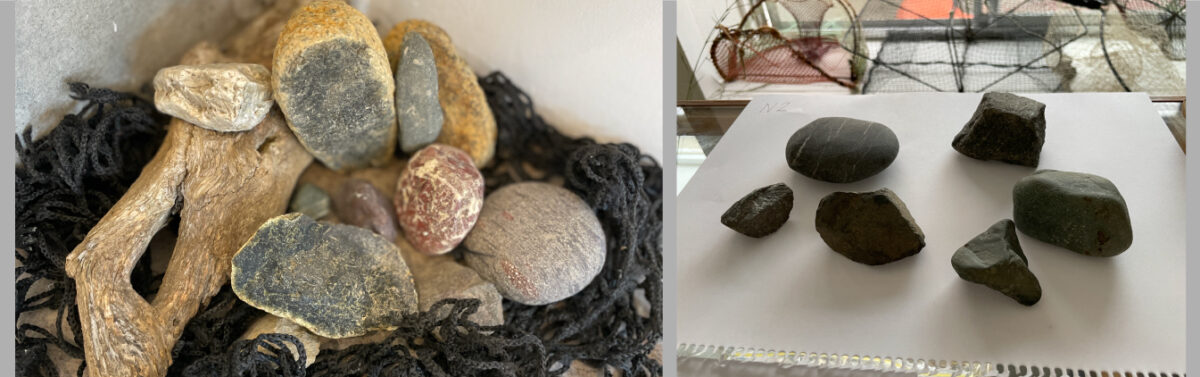
…, though it wasn’t something I’d planned to do. There were various remnants of nets, hinaki, rākau, and even a computer hard drive. It was like it was there for me to gather and learn from. Another toho (teaching). This time, with permission from the residents, I got to take it all home with me.
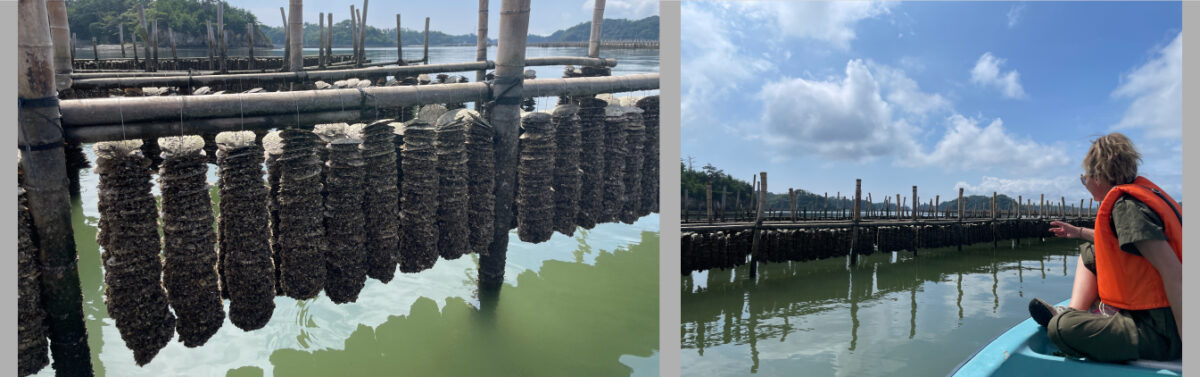
In Aotearoa, there is much less visible “junk” washing up on the shores. There’s an effort (for most people) to keep our oceans and waterways and undo the damage. I started thinking of connected communities and collective knowledge and ancient knowledge being passed down. All around the islands, there were seaweed and oyster farms scattered across. They were all beautiful to me, posts linked together with ropes with bubbly knots of baby oyster.
I had previously visited a recreation of a traditional Nibutani village with Ainu people in their whenua (domain). It resembled a lot like a Māori village or pa (defensive ruins) site. (Read more)
It even had a pataka or food storehouses, and another one for if they found a baby bear. If they hunted a bear and found a baby, they would look after it until they could release it back into the forest. There was a connection around what we call wairua, or the natural spirit in all of us.
That is where it all started when I was at the Ainu Chipsanke Festival. At the waka blessing, I found the remnants of a net, hauled out from the earth during a “waka” (boat) prayer. That’s when my collecting journey started, and it was a natural instinct for me to keep going. On the islands, finding these various versions of nets, they were starting to tell a story of life before us, ancient or recent. And I saw similarities in net-making techniques with our traditional Māori methods—particularly in their construction. The knots used were also consistent.
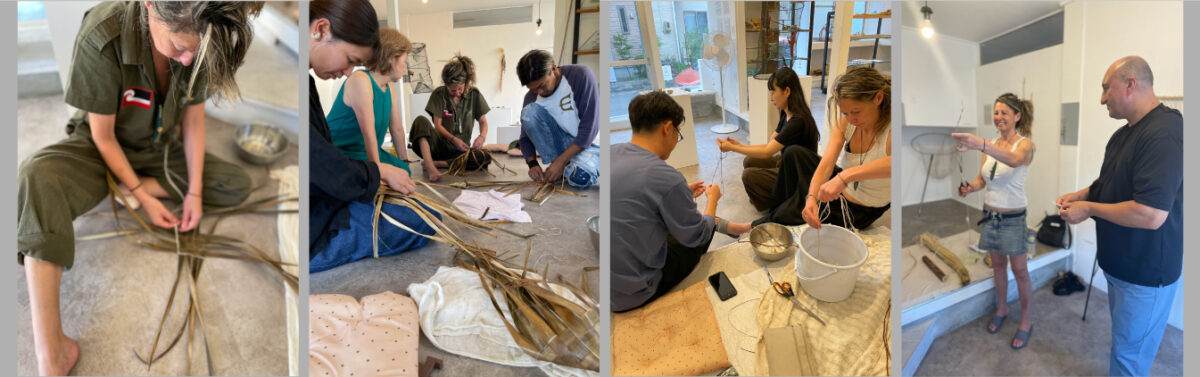
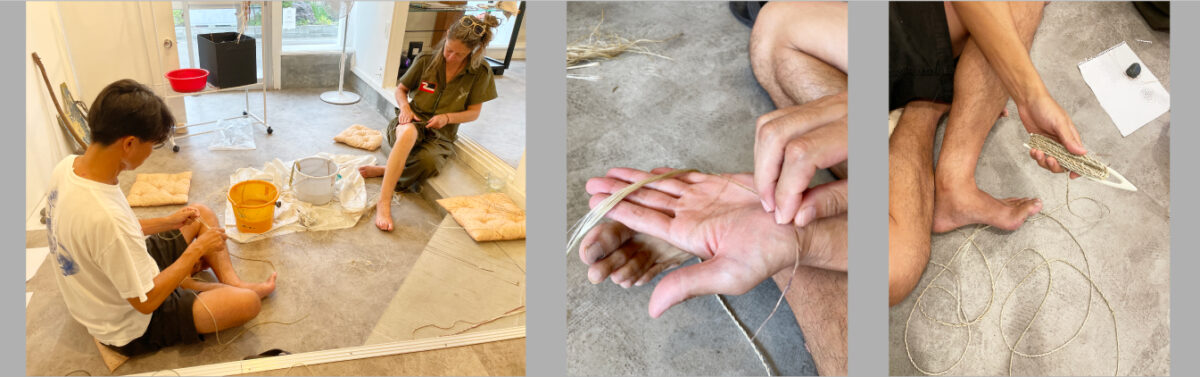
At the exhibition I did at Honda Studio in Autumn 2025, I had bought some woven pieces and kete kupenga from Aotearoa New Zealand and showed some photographs from my travels. I brought a lot of prepared fibers – muka and hatakeke (flax) that we could start making with as an active collaborative wānanga (workshop) space during the course of the exhibition.
[TAKADA] Is there such a thing as Japanese taniwha or Aotearoa taniwha?
[LEE] I don’t think it’s related to the concept of taniwha itself. For instance, in Japan, there is Ryu, the dragon and the Namazu, the catfish, right? (Read more)
If we go back to the concepts of kaitiaki (guardian deities) and tohu (teachings) from nature, I am not sure whether Namazu are considered kaitiaki in Japan. But I can say that found my own taniwha here in the Urato Islands.
Also, these tsunami stones are a little like our pou (carved pillars), which serve as markers. Similar to the way our marae are carved, they reflect creation stories, tūpuna (ancestors), and are always updated with newer stories.
The more you learn about various iwi (tribe) stories, the more they all become similar. Speaking about our Ranagtira – Chiefs and their wives, they also share similar love stories. It always seems to be a little as if each rising chief goes through a similar journey that defines their character as a leader.
[TAKADA] Are Ryu or Namazu ever considered kaitiaki, or guardian spirits?
[ISHIKURA] Initially, I was very surprised to hear that Linda had researched the relationship between the Māori taniwha of Aotearoa New Zealand and the Ryu and Namazu of Japan. The reason is that when I first visited to Aotearoa New Zealand last year and heard several stories about Taniwha, I realized they are not merely protectors. At times, they can be hostile and act against humans, representing an overflowing energy with the power to destroy human society.
I believe they are highly ambivalent beings; it is precisely because they possess such destructive power that they are also capable of providing protection. In other words, I felt that the concept of taniwha, representing all forms of water connected to humans, whether fresh water or sea water, rivers, lakes, or springs, serves to nurture human life while simultaneously posing a threat to it. This idea seems very similar to the oldest period of Japan, so I can clearly understand why such a research question would arise.
It is true that Ryu and Namazu are sometimes regarded as guardians. This is because of one of the oldest Japanese beliefs – that something beyond human understanding lives at the bottom of the water, bringing blessings at times and disasters at others. On Jomon period pottery, various mysterious creatures such as Namazu, worms, fish, and snakes are depicted, often referred to as “Mizuchi.” This term essentially means “slippery creatures associated with water.” While the specific animal is not always identified, the Mizuchi pattern is consistently found on pottery. It was believed that this power granted mothers the ability to give birth and served as the entity connecting humans to the outside world. (Read more)
As time passed, this Mizuchi-like motif appeared repeatedly in Japanese mythology. For example, at Kashima Shrine in the 17th century, the deity of Kashima was originally depicted with the body of a Ryu or snake but with a human face. This deity had a face like an ugly rock covered in oyster shells, yet its body moved in a slippery, snake-like fashion. By the 18th and 19th centuries, this figure transformed into a Ryu (dragon), and later into a Namazu (catfish). It is a process of constant transformation. Thus, a Taniwha-like existence has been inherited in Japan for 3,000 or 4,000 years, acting as both the cause of earthquakes and tsunamis and as a protector of humans. I believe we can consider that the deity Takemikazuchi was born when these beliefs were codified into the sacred traditions of Shinto and its shrines. Therefore, the Japanese explanation for earthquakes is that a slippery being like a Namazu or a whale is living deep beneath the earth, and when it moves, the ground shakes. The deity Takemikazuchi is the one who restrains it, but in reality, Takemikazuchi and the Namazu are the same being. They are two sides of the same existence. The aspect that protects humans becomes a deity, while the aspect that threatens humans becomes a Ryu or a Namazu. In even older times, it was the Ryu or the Namazu itself that protected humanity.
[TAKADA] This resonates with the Japanese as well, but for the Māori people, water is considered a sacred element: the source of life, a symbol of purification, and an element that emphasizes humanity’s existence in harmony with nature. Your exhibition here at Honda Studio was called “Ko wai au – who am I?.” Could you tell us the meaning behind this, Linda?
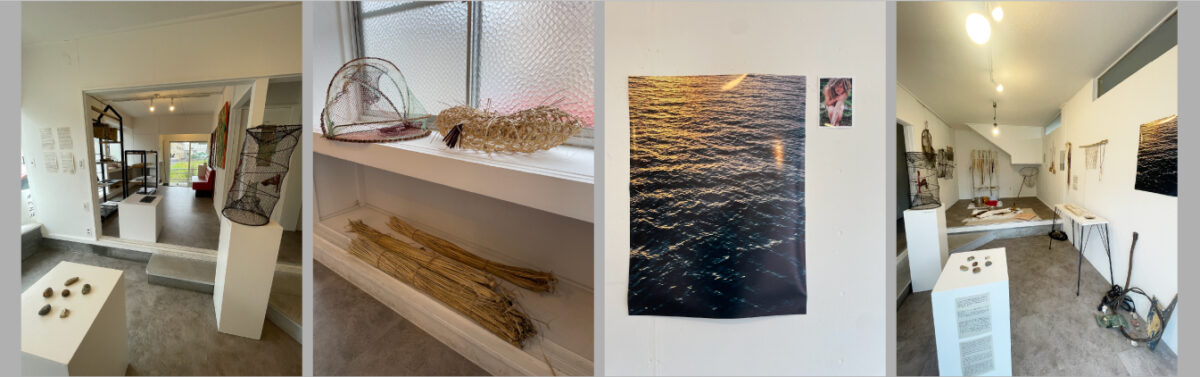
[LEE] “Ko wai au?” carries deeper connections to identity, ancestry, and belonging, sometimes linked to water (“wai”) as the source of life. (Read more)
I remember being told in high school that we are of 70-80% water. When we are born, our bodies are made up of about 75% water. We ourselves are water. It makes perfect sense to me that the water our ancestors were drinking is inevitably within us at birth. Therefore, it is our responsibility to sustain the hauora (wellbeing) and mauri (life force) of ancestral waters to ensure the future generations’ wellbeing.
Mauri is the vital life force or essence present in all things (people, places, objects). Imagine yourself as a tiny stone in a quiet mountaintop pond. The stone is light, gently bouncing. Then you find yourself being rushed down a waterfall at speed, your movement wild and out of control, until you reach the calm bottom rim of this deep pond. (Read more)
You may stay still for a small while until a small shallow stream carries you away on a new journey… You bump into many other tiny stones. Eventually, your stream meets another stream and you are in a river. You find yourself moving at breakneck speed, being thrown up against rock far bigger than you, you may find a break, where you find yourself landed within another cluster of tiny stones to the side of the rushing river. Eventually, you make it to the moana (ocean/sea).
Figuratively speaking, the tiny stone started its journey at the top of the maunga (mountain), goes on its own life journey, sometimes still, sometimes fast and moving out of control, sometimes huddled up tight, feeling safe in a cluster, sometimes bumping into obstacles, but eventually back to the ocean on a journey back to Hawaiki.
Te Rerenga Wairua (Spirits Bay) is sacred to Māori and is at the northern tip of Aotearoa, where the spirits of the dead begin their journey back to Hawaiki.
Hawaiki is the mythical, spiritual, and ancestral homeland of the Māori people, representing the source of life, the place of origin for Polynesian voyagers, and the destination where spirits return after death.
Wairua is the spiritual essence or soul that connects individuals to the unseen spiritual realm. It can be seen as the guiding force that interacts with and gives purpose to the mauri.
Like the path we choose to take, perhaps guided by our tūpuna (ancestors) .I think of mauri as the energy that makes something alive (like a healthy river has strong mauri), and wairua as the spiritual component that gives it meaning, connection, and direction (a person’s wairua connects them to tūpuna or another calling). Maybe similar to Io, wairua sparks our curiosity, questioning, navigation, voyaging, creativity, and art.
[TAKADA] This knowledge you share, this knowledge that is passed down by your tūpuna (ancestors). This is something you have done here as well – including the pepeha (self-introduction), which we did together with schoolchildren in Shiogama.
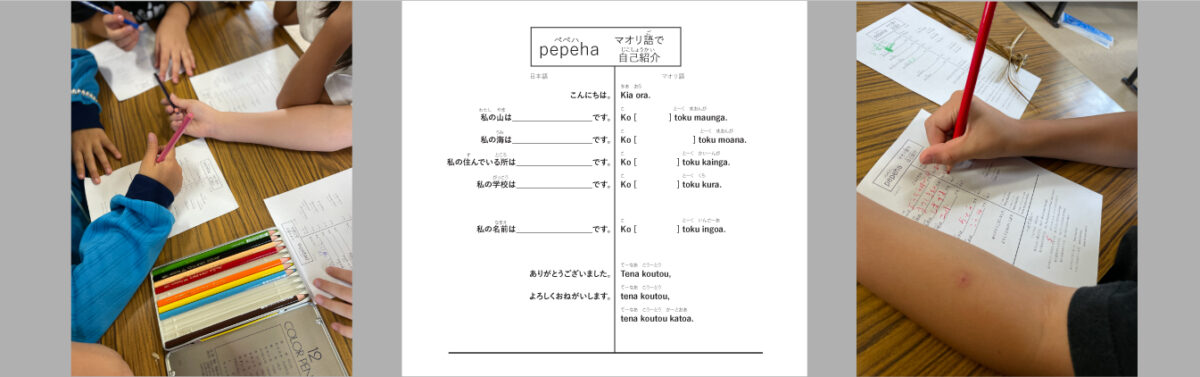
[LEE] Ko wai au? = Who am I? We use it when we introduce ourselves. Pepehā, personal introduction. (Read more)
Normally, I would include earlier generations here in a pepeha, but I don’t have enough time to cover it all this time.
In a traditional pepeha, siblings and children are also included, so I always write my own name last. However, I try to keep it as short as possible.
In Te Ao Māori, life is more circular, as opposed to a linear cycle or life. Our tūpuna (ancestors) are here with us always, guiding us.
Ka oho anō te Ao/ The world has awoken again
Ka whatoro mai ngā hīhī o tamanui/The sun rays shine down upon us
Ko Papatuānuku ki raro nei, tō tātou whaea/Papatuānuku is below our earthly mother
Ko Ranginui ki runga rā, tō tātou mātua/Our sky father Ranginui is above
Ko wai au?
Ko Tainui te waka
Ko Tararua te māunga
Ko Ōtaki te awa
Ko Ngāti Huia te hapū
Ko Katihiku te marae
Ko Ngāti Raukawa te Iwi
Ka hoki taku kitenga ki te Raki
Ko Kurahaupo te waka
Ko Tohoraha te maunga
Ko Waihopo te awa
Ko Houhora te wāhapū
Ko Waiora te marae
Ko Ngati Kuri te iwi
Ko Raharaha te whānau
Ko Manu raua ko Judy ōku mātua.
No Ōtaki au.
Kō Linda au.
So, as I was speaking earlier about references to our navigation, here I start with the waka we arrived on, the mountain, often the beacon for the navigator, the river that provided water to feed the mauri, hauora and wairua of our tūpuna, the subtribe (hapū, almost like an extended family and also the same work for pregnant), the marae (hapū gathering house carved in traditions retelling creations stories – according to that hapū, iwi traditions), followed by the iwi. (Read more)
I started with Raukawa (as it is the maternal side) and then said I would return by vision back to the North and share the same story from the paternal side. This side is strong with me. As for my biological mother, her mother is of the Tainui waka, and her father is of the Kurahoupo waka.
The family is RAHARAHA Nehemia (traditionally in Māori culture, for tane – men – especially, the family name is first, like in Japan) Being whangai, adopted within the family, my Dad and her Dad were brothers from the Rararaha Nehemia line of descent.
So Raharaha is the family. Manu and Judy are my parents. I was born in Ōtaki. I am Linda.
The metaphor of the tiny stone being this life. After we leave this world, our bodies remain and become one with te taiao, water and earth. Our wairua will start the journey north to Te Rerenga Wairua (Spirits Bay), then travel oceans and skies, navigating the stars back to Hawaiki.

So once again, I say it is our obligation to sustain the mauri of our ancestral waters and look for the tohu, signifiers of its hauora (wellbeing), read the signs of the taniwha, to care for our future generations. Very circular and interlinked. (Read more)
All of this was acknowledged in a very short (for Māori) pepeha, self-introduction, commonly used now in Aotearoa.
Performing this regularly, we inevitably find links to each other. The simple recognition of the creation story is a connection. Then, iwi to iwi (or person to person), the Atua acknowledged will change. We may not be linked by hapū or iwi, but to the waka. We may know the family name.
As an army brat (a child of someone in the military or defense forces), it took me a long time to connect to or reconnect with my whenua (land, homeland). I moved around the world when I was a child. I was 19 when I found out I was whangai (adopted), and I just dropped out of art school, hitchhiked north (of Aotearoa New Zealand), and managed to meet both my parents, and all my brothers and sisters knew about me. That was the crazy thing, they were just waiting for the day to meet me. Back then, I didn’t feel very Māori. It takes a long time to actively ‘become Māori’. I went back to art school and started looking at identity, including being Chinese.
Studying raranga (weaving) was the biggest leap. I love being out in the bush and harvesting. Looking after the ‘pa harakeke’ (the flax) – and testing them and watching them crossbreed. My te reo (Māori) was bad, but once I’m in nature, I’m able to pick it up and use it much more than in “language” classes. In the bush, I’m always acknowledging Papatuanuku (the earth mother) and Ranginui (the sky father), the harakeke (flax), and the tūī (a bird). Sometimes it is totally in Te Reo`Māori, and sometimes it’s not. I have a pet tuna (an eel) who’s my best mate down at Ōtari, where I go. We sometimes pet it.
I’ve learnt much more about my culture and cultural identity through living with nature. Visiting taniwha spots, when we’ve done karakai (prayer) and oriori (chants), or taken woven food baskets, there have been tohu, or signs: a rainbow on a cloudy day under a bridge, or a massive flock of birds landing in front of us on the water. Even in the middle of Auckland, a tohu (someone representing a sign) was a boy who kept coming back to us, who took some of my weaving and put it in a crack as what could be an entrance to where the taniwha might be.
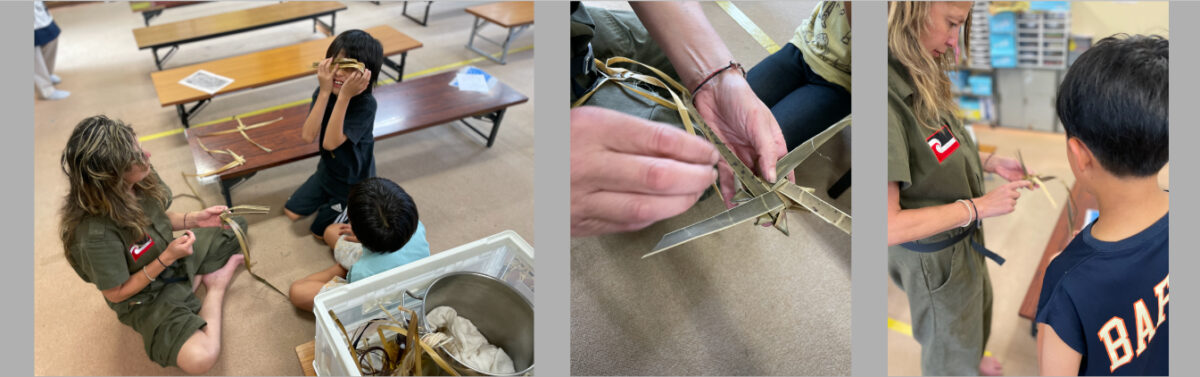
In Shiogama, I used a simplified version of this self-introduction to share this Māori perspective and relationship with nature with local residents and children at the after-school children’s club.
I felt that having the people I met in Miyagi give their pepeha (self-introductions) – asking them about their mountains and rivers, their grandparents and parents, and where they were born – was a great way to raise awareness and consideration for the environment.
We made whetū, stars and putiputi, flowers, with harakeke, flax leaves – all connecting strongly with the natural world that surrounds us.
The Collaboration
[TAKADA] Collaboration is a key word that often comes up in your work here. You have also collaborated with IGARASHI Yasuaki as a joint art work around weaving nets. Could you tell us why it was important to you to include this piece in the exhibition, and furthermore, how does it contribute to your research as a whole?
[LEE] I want to acknowledge the inspiration I gained from my experience with Yasu (IGARASHI), installing the nets in Whairepo (stingray) Lagoon with Shared Lines: Wellington and then his stay with us for Shared Lines: Kaikoura, where he made a new “Sora-Ami” for and with that community after the 2016 Kaikoura earthquake. (Read more)
Yasu previously sailed around the Urato Islands archipelago area. So, reflecting on his experience after the tsunami – he recalled visiting a volcanic island that erupts every 20 years or so, and meeting a fisherman weaving nets, he taught him how that volcanic island encapsulates what it means to be a truly resilient community – it’s that constant rebuilding yourself and reinventing your community to make it stronger and better and yet holding onto these very traditional methods of netmaking. I was really inspired by that.
Something changed within me after the Christchurch earthquakes. I moved to Wellington in 2012 after our first exchange. To be honest, I didn’t go home. I changed my flight. But then I discovered the taniwha formation stories there. It was a spark of a whole new journey for me, creatively and in terms of my identity. When I received my “Sora-Ami (giant nets cast into the sky)” I was like, WOW, how can I do that? But it reminded me of how my dad always had Hinaki and fishing nets and the knowledge passed down. It was something ingrained in my family.
Again, it made me think of Io > Navigation > Curiosity. I wanted to share a more environmentally friendly option for net-making and art-making.
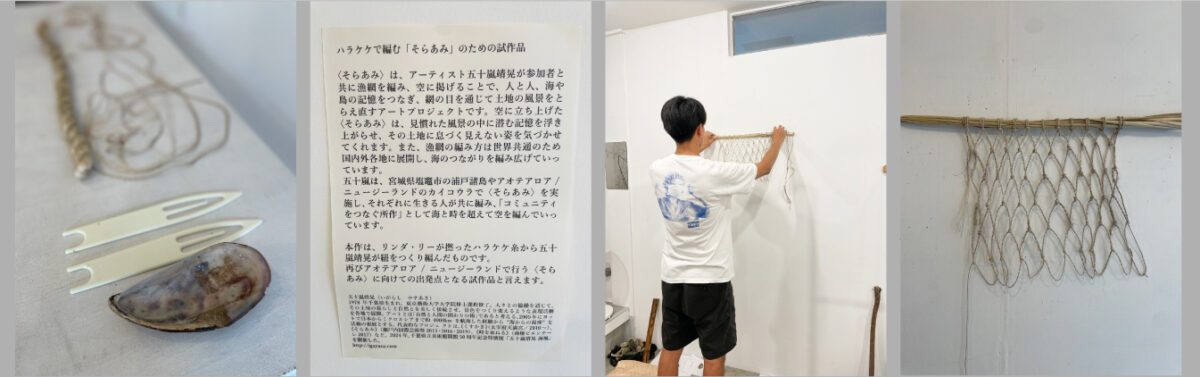
When Māori first arrived in Aotearoa, they had to improvise and create with fibers that were foreign to them. Harakeke and rākau. Experimenting with these fibers, they created shelter, kakahu (clothing), kete(baskets), whāriki(sleeping and floor mats), and Taonga, that gain whakapapa over time through karakia and use. Raranga, weaving as a collective/collaboration, encapsulates netmaking and hinaki. And it’s working with nature. We’re often emulating what nature does, like how a Nikau palm looks; we extend a piece of weaving using whiri, a plaiting technique. In Polynesia, they weave with coconut palms and pandanas.
Natural resources will always be here, even when power plants might not. I hope these simple gestures can impact on our relationship with natural disasters.
*Whiri: A technique for weaving plant fibers to make ropes and cords. Maori weavers often use this technique to make sturdy necklines and cords for their cloaks.
Discussion
[TAKADA] Linda’s work has led to increased awareness and understanding of our relationship with nature, and has sparked dialogue about customs found in Maori and Miyagi cultures. Ms. Ishikura, could you tell us what similarities and differences you’ve noticed from what we’ve discussed so far?
[ISHIKURA] Regarding commonalities, I believe the water surrounding humans is not just something that exists within a space like a sea or a river; instead, it is a constant flow that circulates through heaven, earth, and the underworld. In Japan, the dragon is naturally associated with rain, which becomes rivers and flows into ponds, lakes, and the ocean, eventually encompassing the water of the entire planet. I suspect that in the Māori world, while there are spirits acting as guardian deities of specific places, they are similarly connected to the entirety of the environment surrounding humans.
As for the differences, the distinction between Aotearoa New Zealand and Japan lies in their respective histories. In Japan, these concepts were neatly refined through religions like Shinto and Buddhism, eventually becoming “gods.” In a sense, they were transformed into human-like deities, as seen with Takemikazuchi.
Taniwha do not become human. They survive as part of nature, taking various forms such as logs, rocks, lizards, or eels. I believe this represents a much older way of thinking that has remained intact in Japan.
An important point is that Australia also has the “Rainbow Serpent,” an entity that connects heaven, earth, and sea, representing a grand circulation. When we consider this, the commonality between Japan and the Māori is part of a broader indigenous world across the Pan-Pacific region, including Australia. The difference lies in how humans have interacted with these forces, how they have perceived them, and the specific forms they have given to them.
[TAKADA] Have these varying cultural perspectives influenced the way you see natural disasters?
[ISHIKURA] I have been researching mythology for a long time, I have come to deeply understand how complex and intertwined the relationship between humans and non-human entities has been since ancient times. Nevertheless, I believe mythology teaches us that disasters can occur without warning and that unavoidable events can happen at any moment.
What I mean is that the ambiguity found in folklore – the fact that nature provides both good and bad things – reminds us of how much we already receive from the natural world every day. When an earthquake or tsunami occurs, we tend to think of it as a sudden “bad” event, but folklore teaches us that this is merely the other side of the many blessings we receive.
Speaking from my own experience, when I lived in Tokyo, I took things like electricity and water for granted. However, during the Great East Japan Earthquake in 2011, everything was suddenly shut down: there were power outages, water became unavailable, and infrastructure was destroyed. In a sense, I believe disasters reveal a perspective that challenges our human-centric way of thinking.
Ultimately, I think that mythology is something that humbles human beings. Instead of living in a world where we dominate and control nature to live in comfort and convenience, we need to move toward where we maintain a balanced relationship with nature. We need to think we can give back to nature and how we can care for what we receive. Have we forgotten the prayers, rituals, and ways of celebrating festivals that people of the past practiced, and are we now merely exploiting only the convenient aspects of nature? I believe the Great East Japan Earthquake taught us this.
For this reason, I believe that researching folklore and living through disasters are essentially the same thing. I am currently involved in the arts, and I see the acts of creating work, writing papers, and conducting research as efforts to make humans more humble. It is a process of rediscovering how to reconstruct our relationship with nature and how to encounter the Earth and the world of living things once again.
[LEE] Small gestures like introducing sustainable materials, collecting “junk” from the shore and reciting pepeha can impact the way we see and care for our environment, (Read more)
We bring up *Dr. Dan Hikuroa’s question, “What can the weaving of Mātauranga* (wisdom) and Science contribute to our understanding?”
He shares that “I work mostly on community-driven and participatory projects with Māori, including using ocean resources sustainably; plans for managing environments and natural resources; reducing the risk of disaster from natural hazards; and restoring industrial waste sites.” His research asks: What can the weaving of Mātauranga and Science contribute to our understanding?
“We see Papatūānuku me ona uri (and her descendants) as our teacher. I use pūrākau, maramataka and moteatea as primary sources; they provide historical evidence that’s otherwise unavailable. We test that information with local Māori to ensure that what we think it has recorded is what they think. Scientists have recognized that information in those sources has been developed from constant observation, and can be precise.”
“Any scientific testing we do that is inspired by pūrākau isn’t done to prove it. If we find the same answer, we have two sets of knowledge telling us the same thing. Mātauranga can tell us things that science can’t, and vice versa.” He gives the example of a pūrākau about a taniwha in the form of a ngārara (lizard) living in the Waitepuru stream, in the Bay of Plenty, whose tail in the Rangitaiki Plains is said to flick from side to side. The presence of a taniwha suggests a danger associated with the stream, which has changed its course over the plains many times over the centuries after large floods. The taniwha was taken into account when selecting sites above the flood plain for the three marae in Matatā, none of which were damaged when flood debris smashed into the town in 2005.
“Demonstrating that Mātauranga Māori can be accurate and precise.” An example is a study about the mauri (life force) of Te Awa o te Atua, the Tarawera River. Dan and the team developed a scale to measure the environmental, social, cultural, and economic indicators of mauri, as described in a wānanga organised by Te Mana o Ngāti Rangithi Trust.
Another example is a model of water allocation, Ngā Puna Aroha, based on tikanga. Puna is the deepest source of freshwater, while aroha is the love and respect that is essential for a healthy relationship between us and our ancestral bodies of water. The first allocation, Ngā Tipuna, reflects our obligation to sustain the wellbeing and mauri of these ancestral waters.
The second, Ngā Mokopuna, is for the basic needs of people and animals, wild and farmed. The third, once those have been satisfied, is Ngā Koha Puna, commercial use.
“Proving that the anti-fouling paint on boats moored in Auckland’s Okahu Bay was poisoning the seafloor; this led to the removal of all boats from the in 2019.” The study was part of an relationship between Ngāti Whātua o Orakei and Dan and other University of Auckland scientists and students. “
The Whanganui River is now considered to have the same rights as a human in Aotearoa New Zealand.
*Dr. Dan Hikuroa (Gati Maniapoto, Waikato Tainui District; Gati Fanaunga, Pakeha District): Holds a PhD in Geology. Currently an Associate Professor of Maori Studies, Te Wananga o Waipapa, University of Auckland. Teaches anthropology, geology, sustainability, environmental engineering, and business studies.
*Mātauranga: Traditional wisdom and knowledge of the Maori people.
[TAKADA] Looking into the present, have you noticed anything particularly striking about how people living in Japan deal with natural disasters in their daily lives?
[LEE] During my visit to Japan, I met people in a community in the Urato islands. They were all full of life. They were very different – on a different life buzz from the city people. The same with the Ainu community – really hardworking, fighting for their culture to survive, because they were only recognized as indigenous in 2019. Hence, the relationship with Māori. I met two very different communities, which you don’t associate with big city Japan. City life is so different to these communities.
When the earthquakes happened in Ōtautahi Christchurch (in 2011), the first communities that really knew how to support and awhi (comfort) those left homeless or without electricity were the Māori. The same thing happened in Kaikoura, where the marae (meeting houses) are built on high ground. Navigation systems allow people to know how to get there, and to avoid things like tsunamis. Beyond that, it was built on a high point and a spot less susceptible to earthquake and tsunami damage.
One thing I noticed as a difference in Japan was that, after the tsunami, things were rebuilt within a year, whereas in Ōtautahi it took so long. And now, going to Ōtautahi, it doesn’t feel like home anymore. Some of the people feel like home, but I get lost in town. I don’t know the landmarkers anymore. Tall buildings, pou (carved pillars), beacons are missing.
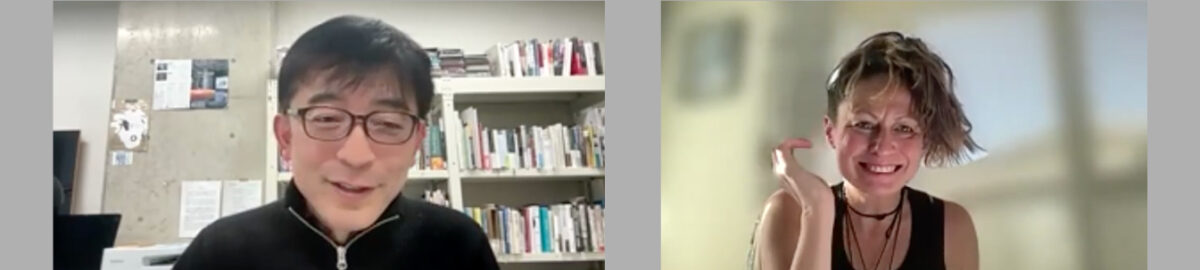
[ISHIKURA] If you look at the Namazu-e (catfish prints) from the late Edo period, there are scenes where everyone is rejoicing and laughing as an earthquake occurs. This implies that an earthquake was not just a time for weeping: it was an opportunity for money to move around, and for commoners to make money and a living. By rebuilding houses, wealth would circulate to those who were economically poor. In this sense, an earthquake was not viewed as entirely negative; it was seen as a chance for rapid recovery, where carpenters would work hard to rebuild the town.
In Japan, even when towns were destroyed repeatedly by fires and earthquakes, they were always able to recover quickly. I feel that the difference from Aotearoa New Zealand may lie in this specific culture: the idea of living atop slippery creatures like catfish or whales, where society accepts that things will break easily, but also maintains the resilience to rebuild them immediately.
[TAKADA] Finally, could you share a few words to how or what can ordinary people can take home from understanding this experience, and how they can apply this moving forward in their daily lives?
[ISHIKURA] I think the line defining what we call a “disaster” is very subtle. In Akita where I live, it is snowing heavily; however, if this same amount of snow fell in Tokyo, it would likely be a major disaster. Similarly, if a typhoon that occurs in Okinawa were to happen in Tokyo, that too would become a disaster. In other words, we can think of our relationship with nature as the very thing that creates a disaster. Looking at it this way, a disaster is not simply a “disaster” because a certain event occurred: it changes based on how humans perceive and receive it. In our daily lives, we design our cities to make them easy for humans to live in. However, we should be more humble and recognize that nature involves many other types of living beings. We should design our world by remembering our deceased ancestors and considering the children yet to be born. I believe the key to preparing for disasters lies in how we design a society based on this kind of long-term thinking.
Another point is that nature is always in motion; it is fluid and unstable. Our way of responding to this must also involve using our wisdom to remain constantly fluid and adaptable. In that sense, for example, there have been many bear sightings in Akita. Rather than simply culling and killing them; we must rethink how they can return to the forest. To put this into practice, I believe we can learn a great deal from ancient wisdom and the knowledge of decolonized indigenous peoples from other regions, such as the Māori.
One more thing I would like to add is that I believe Japanese people should learn from how the Māori in Aotearoa New Zealand are currently integrating biculturalism; specifically, how they have established and implemented formal legal frameworks to protect the natural environment.
The Treaty of Whanganui River for instance, recognizes various environmental entities such as the Whanganui River and certain mountains. They are recognized as legal entities, and this concept is deeply embedded in Māori indigenous culture. Aotearoa New Zealand is leading the world in granting legal agency to nature, whereas Japan is significantly lagging behind in this area. For instance, indigenous people in Japan are still not granted the inherent rights to fish in rivers. Regarding these issues, I believe there is a great deal that Japan ought to learn from the Māori.
[LEE] Yes. I may have already mentioned about this. The taniwha and creation stories that can be uncovered from carving or on stones are examples of this. We need to listen to those who hold the knowledge.
Traditional narratives are a way of passing on important information from generation to generation in oral cultures. In many different traditions across the world, stories are passed on intergenerationally, preserving information about such things as ancestry, history, geography, which plants are edible, and which rivers are dangerous. The information is embedded in stories, the stories are entertaining, and there are specified times when the stories are told as well as expectations about the accuracy of re-telling. All of these things contribute to the successful transmission of information.
We all sit on the Pacific Ring of Fire. I believe it’s important to use our senses. If we consider our taniwha to be kaitiaki, we need to listen, see, hear, and use our senses—our intuition.
We need to look at ways to rebuild with a decolonised perspective. We need to make city spaces better for community building. And given the opportunity during a city rebuild… why not?
And most especially, we need to be in tune with nature.
Closing
[TAKADA] Disasters are a common reality in modern society, and many natural disasters occur not only in Japan and Aotearoa, New Zealand, but also in the region surrounding the Pacific Ring of Fire. Earthquakes are also frequent in Myanmar, the Philippines, Thailand, and the Middle East. As shared in today’s discussion, people have turned to myths and folktales, and have tried to understand natural disasters by looking back at folktales and history, as a means of seeking understanding, reassurance, and wisdom.
Linda Lee believed there were commonalities between the myths and folktales of Japan and Aotearoa, New Zealand, and conducted research in Miyagi Prefecture. She hopes to deepen her understanding of resilience and reaffirm the importance of coexistence between humanity and nature by drawing lessons from these myths and folktales. In this increasingly divided era, continuous dialogue is essential for the global community to support each other and overcome these challenges in order to prepare for future disasters. Raising awareness, cooperating together, and fostering a sense of solidarity are more important than ever.
Amidst the various conflicts occurring around the world, some may view natural disasters as a simple A vs. B situation. However, this is neither a human vs. human situation nor a human vs. nature situation. Natural disasters serve as a wake-up call, making us pause and reflect on the true meaning of things. They remind us once again that nature is the great guardian of our shared home, Earth.
And an honest reminder of how nature is the grand caretaker of our earth which we call our collective home.
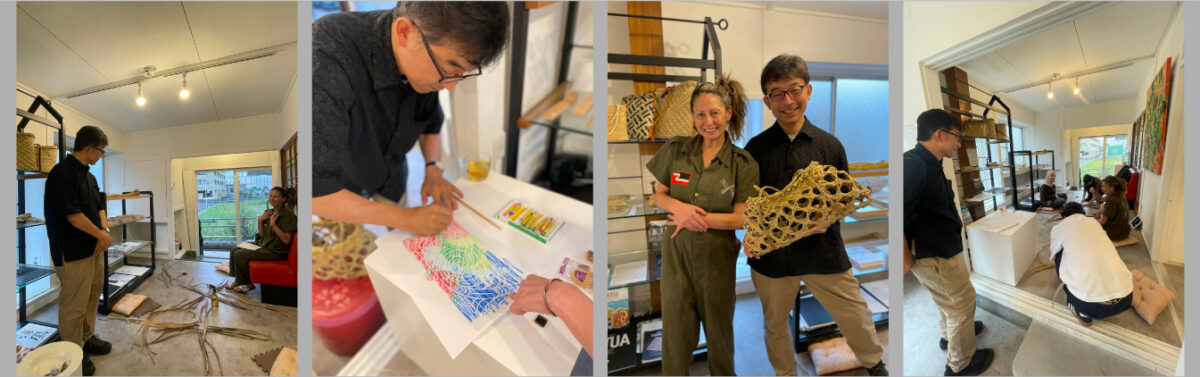
We’d like to express our sincere gratitude to Linda LEE from Aotearoa NZ, and ISHIKURA Toshiaki from the Akita University of Art for taking the time to participate, exchange. and discuss these ideas together. Thank you very much for sharing your time with us.
– END –